Showing posts with label Fitting problems. Show all posts

Designer Secrets - The Chest vs. the Bust measurement


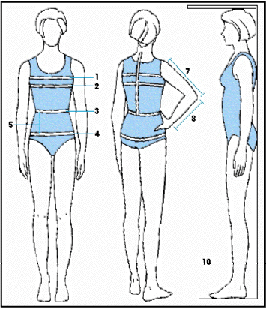
The chart on the right comes from here The one on the left is from here It's the CYCA chart that many Knitting designers use as a standard when grading all patterns. The one on the right shows a chest measurement at 1 and a bust measurement at 2. CYCA shows only a bust measurement.

I rarely knit from patterns. On the odd occasion I do it's usually because the design has a feature or technique I'm really interested in trying. The last pattern I knit was this
one It's beautiful!


As you can see with this design the pattern size choice based on a bust measurement makes sense but it doesn't for every pattern. In particular those with set in sleeves. I've been custom designing for my own unique measurements for so long that I'd forgotten how difficult it can be for Knitters to choose the correct size when using patterns. When I was taking sewing classes I was taught to take both bust and chest measurements to aid in choosing the correct pattern size especially if you were over a B cup. The thinking was that while bust measurements gave you the width required the chest measurement was more closely based on bone structure size. Normally it is easier to make the bust bigger than it is to change the shoulder, armhole and sleeve cap relationship. If I use the CYCA standards I drop a size by using the chest measurement. My back waist length isn't even on the chart because I'm 5'2". If I look at my upper arm measurement I go up a size? I sound like I must be some sort of a science fiction mutant don't I? Well I'm not... I'm pretty average. So what I'm getting at here is that it doesn't really matter what standard measurements a designer starts from because the reality is that almost every knitter will need to make some adjustments to fit their pattern to their body. You will always need to compare your measurements to the patterns and adjust accordingly. So try taking a chest measurement especially if your sweaters don't fit at the shoulders and neck and see if that changes the size you would change on the pattern. See this previous posting for an adjustment idea if you need more space in the bust area only and this one here for making your sweater fronts bigger.

Make it Fit


I have a secret about why my sweaters fit better than the ones other knitters make from patterns.


I always make my fronts bigger than my back. I do this because I've measured myself not as a single measurement around my bust but I've also taken a measurement from one side seam to the other. Let me recheck those measurements right now........


OK I'm back wearing my favourite bra which has a little padding and makes the girls sit up, (you do know to measure while wearing a bra right?) My full bust measurement is 40.5 inches so 1/2 would be 20.25 inches. I next measured my front only from side seam to side seam. That measurement is 23.5 which means that my back is 17 inches.


I took sewing classes for many years as well as pattern drafting and tailoring. I learned that generally when we gain weight we gain more on our front than we do on our backs. I write my own patterns from scratch so I can make all the numbers work out. For those of you working from patterns if you want to try my technique for better fit you will need to knit two sizes - one for the front and one for the back. You need to check your pattern carefully to make sure that all edges that join (shoulders and side seams usually) match. The front shoulders will need to be made narrower so the way to do this is by working extra decreases at the neckline. You may also need to add extra rows of length to the smaller back to make it match your front if the pattern gets longer with every size increase. The numbers will always be different depending on the specifics of the pattern you are using but you can work through these details by carefully analyzing the schematics and the written pattern. So let me know are any Knitters already doing this?

Make it Fit - Designer Secrets and Why Sizing is so Difficult


Sizing is the biggest problem that most hand knitters face. When shopping for ready to wear clothing we have a plethora of size choices; juniors, misses, petites, plus petites, plus sizes and tall girls to name just a few.

When sewing the category names are different but to offer just one example Vogue patterns come in 5 different ranges. The following information is from their website.


"Misses’ patterns are designed for a well proportioned and developed figure; about 5'5" to 5'6" (1.65m to 1.68m) tall without shoes. Misses’ Petites patterns are designed for the shorter figure; about 5'2" to 5'4" (1.57m to 1.63m) tall without shoes." There are 11 sizes in these 2 ranges from a bust of 30 ½ inches to 48 inches.


"Women’s patterns are designed for the larger, fully mature figure, about 5'5" to 5'6" (1.65m to 1.68m) tall without shoes.Women’s Petites patterns are designed for the shorter woman's figure; about 5'2" to 5'4" (1.57m to 1.63m) tall without shoes." There are 10 sizes in these 2 ranges from a bust of 36 inches to 54 inches.


"Today's Fit patterns are designed for the changing proportions of today’s figure; about 5'5" without shoes. The waist and hips are slightly larger than Misses’ and the shoulders are narrower." There are 10 sizes in this range from a bust of 32 inches to 55 inches. This comes to a total of 52 different sizes.


Most hand knitting patterns come in from 3 to about 7 sizes with no variation in length or figure type. There are many reasons for this simplification several being due to cost, publication space, the difficulty of grading each size individually,the inability to have every size test knit as well as an industry that underpays designers. So what's a knitter to do? I'm still thinking about this. As a designer I'm considering doing patterns that would target these specific markets but the question is would you buy them? LMK what you think.

Why You Don't Like the Sweater You Just Knit


This happens to all knitters at some point. We take the time to choose a pattern, pick out a yarn in a lovely colour and start to knit. Weeks??? or perhaps months later we cast off, do the finishing and block the garment ready to wear it and proudly show off our talents.


Then we stand in front of our mirror feeling lost and hopeless because it's not the sweater of our imagination. So where did you go wrong?


Did you pick a colour of yarn totally alien to the rest of your wardrobe? It's not that unusual to see Knitters admiring beautiful yarns in colours that don't fall into the palette of what they wear or in a colour that is not flattering to them personally. The colour of the sample is always the first colour to sell out in a yarn shop so your LYS staff know that you are admiring the garment and not really thinking through how it will look on you.


Did you substitute the pattern yarn with an appropriate match of fiber and gauge? This situation is becoming more frequent as Knitters are buying patterns to stash bust the yarn they already have. Yarn substitutions are always possible, however the Knitter does need to understand that the work may not be an exact replica of the original. Sometimes the knitted item is lovely but because it is different or unexpected from the original we are not happy with the end result.


Did you choose a pattern that flatters your body shape. Just because the garment looks great on the model who is a 34 bust and 6" taller than normal women doesn't mean it will look good on everyone. Think about the most flattering items in your wardrobe is this pattern anything like other things you wear?


Did you knit an item appropriate to your personal style? Are you a twin set girl and the pattern is an Asian inspired asymmetrical style? If it is think twice before casting on or consider modifying to be closer to your personal style.


Did you knit an item appropriate to your personal lifestyle? Did you choose an over sized sweater suitable to be worn with jeans and hiking boots for long walks in the country on cool fall days but you live in a city and socialize with serious fashionista's who wear sharp tailored clothing?


Did you understand the way the garment fit? Sometimes the photo's do lie! The stylist pinned the garment at the back so you think there is waist shaping or negative ease and in reality the garment is one big box in shape. Carefully review the schematic and the instructions to make sure you are knitting what you think you are.